
Discussion/Conversa: Where Does Fascism Comes From and Does it Disappear?
Until recently, there was a widespread assumption that fascism had been decisively defeated, because the horrors of the IIWW appeared to have rendered it morally bankrupt and politically untenable. Yet, in the early twenty-first century, fascism has resurfaced, adapting to contemporary conditions and finding new modes of expression. Does this mean that fascism disappeared and then resurrected? Or does fascism remain latent within society, resurfacing whenever capitalist dynamics intensify inequality, labour precarity, uncertainty, and social dislocation? But if fascism is a symptom of capitalism’s recurring crises, why societies and the social sciences did not see it coming? Why were the warning signs generated by these social and economic conditions overlooked during decades in which fascism was widely considered defeated? Addressing these questions, the premise of this event is that fascism has an elusive, ambiguous yet expansive logic capable of permeating multiple dimensions of social life. In consequence, fascism’s conditions of emergence and its modes of operation cannot be depicted and adequately understood except through an expansive critique of society that examines fascism’s entanglements with capital, race, gender, nation, and empire.
——————————————————————-
Speakers
Ewa Majewska (SWPS University, Warsaw)
Fabian Freyenhagen (University of Essex)
Tiago Saraiva (Drexel University)
——————————————————————–
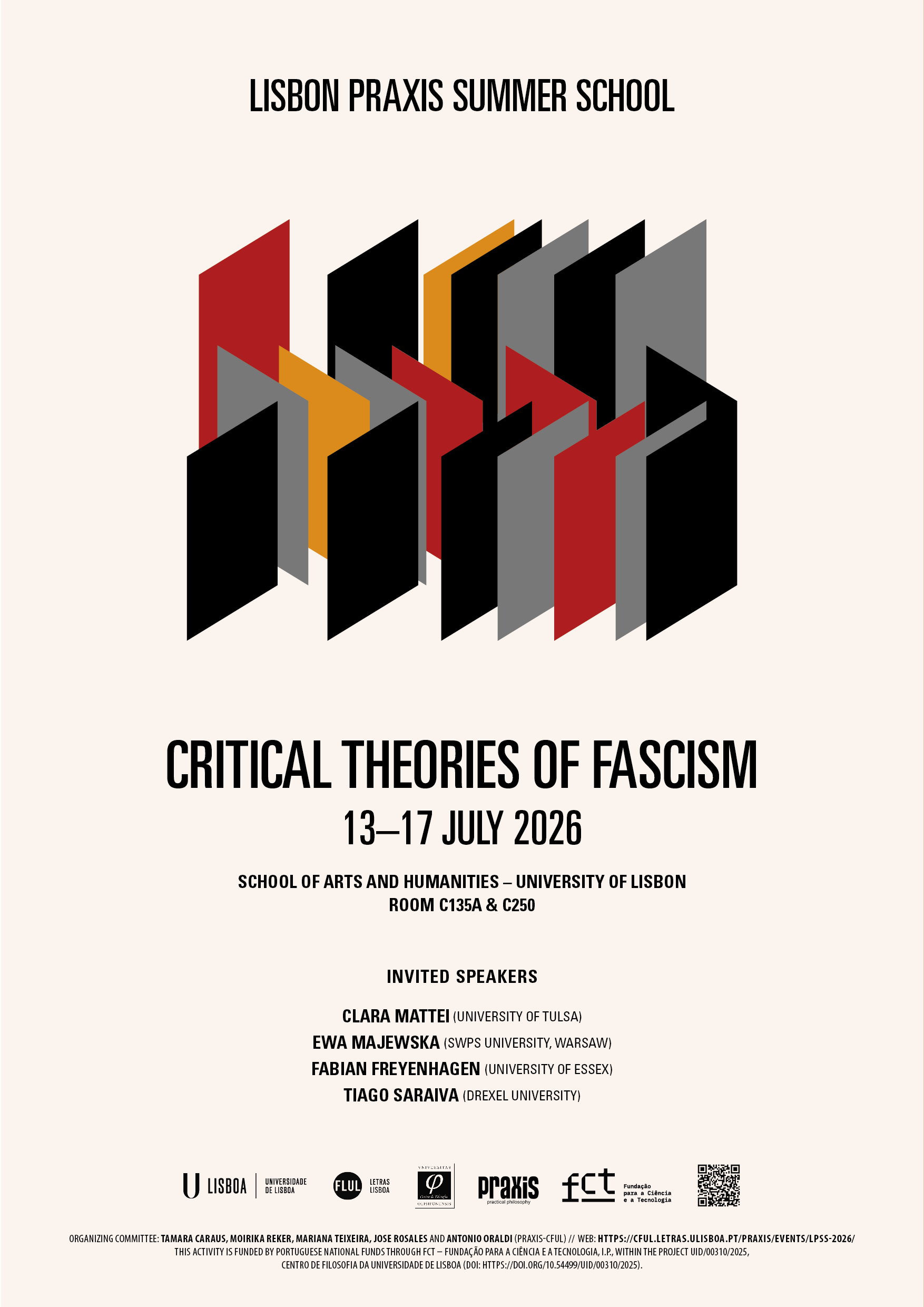
This event is part of the Lisbon Praxis Summer School, Critical Theories of Fascism, held at Faculdade de Letras, Universidade de Lisboa, July 13-17.